

The future of SaaS is AI-driven: New report reveals key strategies for 2025 and beyond

The future of SaaS is AI-driven. That is not a forecast anymore, it is the present tense of the industry. The question that matters is not whether AI changes SaaS, but how the shifts are reshaping product design, pricing, infrastructure cost, and team composition. Our 2025 industry report captures the patterns we have seen across over 100 client engagements in the past year. If your SaaS roadmap includes AI features, build the AI-driven SaaS your roadmap needs.
Key takeaways
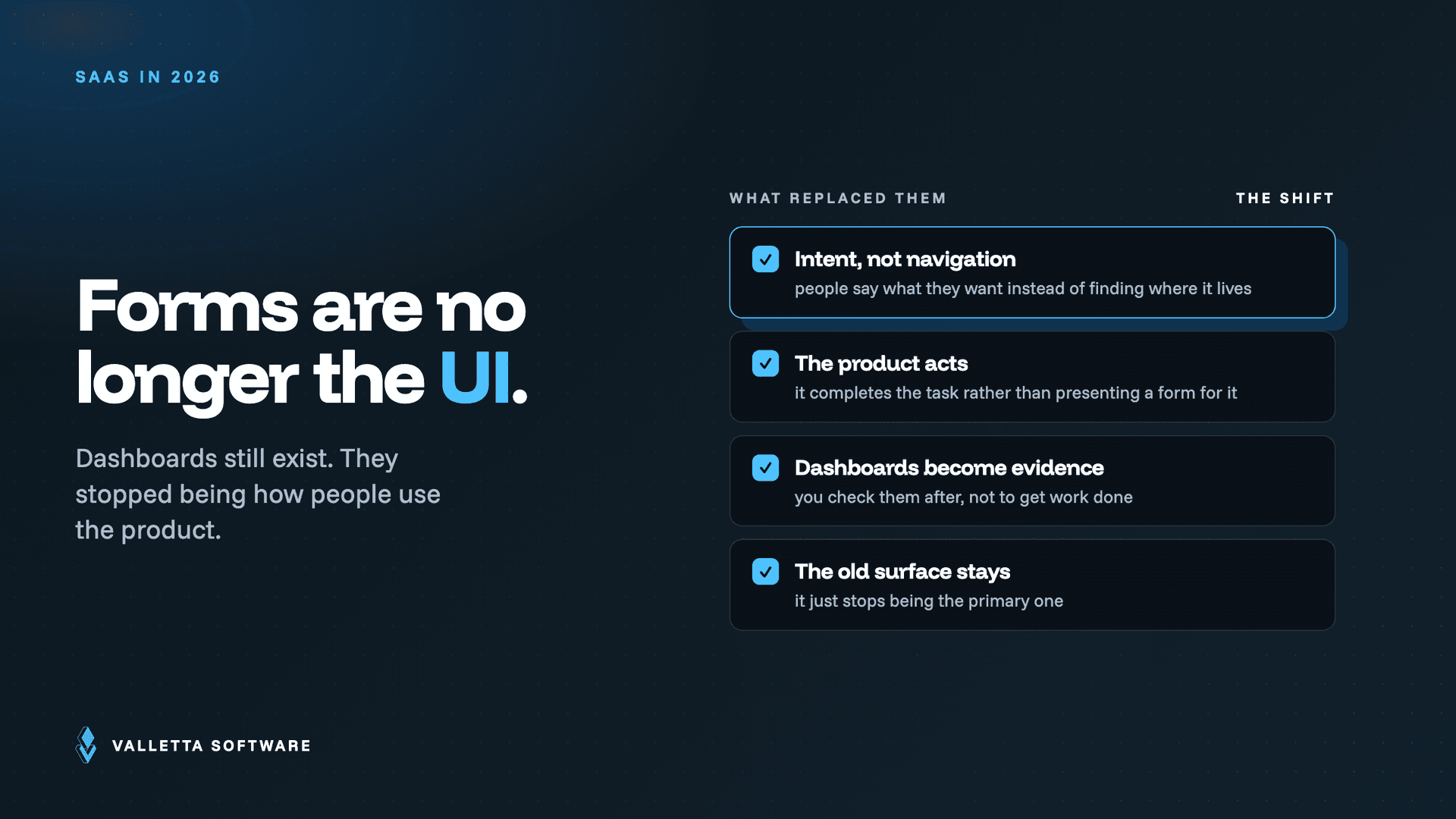
- Product UX is being rewritten around natural language as a first-class interface. Forms and dashboards still exist, but they are no longer the primary way users interact with the product.
- Pricing models are decoupling from seats and moving toward usage and outcomes. Per-seat pricing now penalizes SaaS vendors as AI features reduce the number of human users needed.
- Infrastructure cost has bimodal distribution. Companies with disciplined AI infrastructure run lean; companies without it bleed margin to inference and storage costs.
- Engineering teams are smaller per unit of output, but require new specializations: AI/ML engineers, evaluation engineers, prompt operations.
- The competitive moat is shifting from feature parity to data quality. Whoever has the best proprietary data wins the AI feature comparison.
The product shift: natural language as default interface
SaaS products in 2025 are routinely launching with conversational interfaces as the primary entry point. The forms and dashboards are still present, but the user's first action in the product is increasingly to ask a question in natural language. CRM tools answer "show me deals at risk this quarter." Analytics platforms accept "compare conversion rate by channel for last month." Customer support tools respond to "draft a response to this ticket based on our knowledge base."
The implications for product teams are larger than they first appear. Onboarding shifts from "learn the menu structure" to "tell the product what you need." Documentation shifts from "how to use feature X" to "what the product can do." Feature discovery now depends on the AI surface area: a feature that the conversational interface cannot trigger effectively might as well not exist.
Pricing: from seats to usage to outcomes
Per-seat SaaS pricing made sense when each additional user produced incremental value for the customer. AI changes this calculus. An AI-driven product that helps a five-person sales team perform like a ten-person team should not be priced lower as a result.
Three pricing models are emerging in 2025:
- Usage-based. Tied to actions performed (queries, generated artifacts, automated workflows). Most common for AI-native products.
- Outcome-based. Tied to business results (qualified leads generated, tickets resolved, conversions). Higher upside, harder to implement.
- Hybrid base + usage. Predictable baseline plus variable component. Most common for incumbent SaaS vendors transitioning from per-seat.
The shift is not optional for SaaS vendors competing in AI-heavy categories. Per-seat pricing now creates an adverse selection problem: customers reduce seats as AI features make them more productive, which directly cuts vendor revenue. Vendors who do not change pricing model will see ARR per customer fall.
Infrastructure cost: the bimodal reality
AI features run on expensive infrastructure. The cost trajectory of running a meaningful AI capability in production has flattened in 2025, but it remains an order of magnitude higher per user than non-AI SaaS features. Two clear patterns separate the SaaS vendors who handle this well from those who do not.
The disciplined vendors invest early in inference cost optimization: prompt caching, smaller models for routine queries, hybrid retrieval (small + large models in tandem), and rigorous evaluation pipelines that catch regressions before they reach production. They run AI features at gross margin similar to traditional SaaS.
The undisciplined vendors send every query to the largest available model, retry naively on failure, do not cache aggressively, and run inference costs at 20% to 40% of revenue. They face a structural margin problem that compounds as usage grows.
Engineering team composition
Engineering teams in AI-native SaaS companies are smaller per unit of output than their 2022 counterparts. AI-assisted development has measurably increased per-engineer productivity in code generation, code review, and routine bug fixes. The teams shipping comparable products in 2025 are 30 to 50% smaller than they would have been three years ago.
The composition is also different. Three roles have moved from "nice to have" to "essential" by 2025:
- AI/ML engineers who can build, fine-tune, and operate model inference pipelines.
- Evaluation engineers who design and maintain the test suites that validate AI feature quality over time.
- Prompt operations engineers who manage prompt versioning, A/B testing, and runtime configuration of the AI surface area.
The good news is that these roles cost less in cumulative team headcount than the savings AI brings to traditional engineering. The bad news is that they require new hiring strategies and are scarce in the labor market.
The new competitive moat: proprietary data quality
Feature parity used to be a slow race; competitors took years to close gaps. AI changes the race speed dramatically: a feature that takes a competitor two months to ship can be matched in two weeks with help from foundation models. This compresses traditional moats.
The moats that hold up in 2025 are about data, not features. Specifically: domain-specific labeled data that improves model performance for your category, customer interaction data that personalizes your AI surface, and operational data that informs your AI's reasoning. Companies that built data infrastructure discipline early are now extracting outsized value. Companies that treated data as a byproduct are scrambling.
What this means for SaaS founders in 2025
Three concrete moves that B2B SaaS founders should be making by mid-2025:
- Audit your pricing model for AI exposure. If reducing the number of human users helps your customer, your per-seat pricing is upside-down.
- Build inference cost discipline before scale forces it. The teams that do this early run AI features profitably; the teams that wait spend the next two years retrofitting.
- Treat data infrastructure as a first-class product investment. The data quality moat will not narrow once it forms; it widens.
For deeper takes on specific aspects of this shift, read our AI development services cost guide, our enterprise AI agents implementation guide, and our scaling SaaS pillar. For industry-level data, see Bessemer's State of the Cloud reports and a16z research on AI in enterprise software.
Frequently asked questions
Will all SaaS become AI-driven?
Not all SaaS will have generative AI as the primary interface, but almost all SaaS will have AI capabilities woven into the product. The split between "AI-driven" and "AI-augmented" will become less meaningful by 2027 as the augmentation patterns become standard.
How fast is the pricing shift happening?
For AI-native products: already shifted. For incumbents adding AI features: 12 to 24 months from start of transition to new pricing in production. Companies that delay this transition past 2026 face a structural revenue pressure problem.
What about open-source models?
Open-source models have closed roughly 80% of the capability gap to closed frontier models by 2025. They run cheaper on owned infrastructure and offer better data residency control. The trade-off is operational complexity and ongoing tuning effort. For SaaS products with consistent inference patterns and cost sensitivity, open-source has become the rational default.
Do small teams have a chance in AI-driven SaaS?
More than ever. The barrier to building competent AI capabilities has dropped sharply with foundation models and developer tooling. A four-person team in 2025 can build what a 15-person team would have shipped in 2022. The constraint shifts from engineering capacity to distribution and customer trust.
What is the biggest mistake SaaS vendors are making in 2025?
Treating AI as a feature add-on rather than a re-platforming opportunity. Vendors who bolt AI onto existing UI and pricing without rethinking either get incremental improvements. Vendors who rebuild around AI capabilities get step-function gains. The mid-point of half-rebuilt products is the most expensive position.
Frequently asked questions
- How is AI changing SaaS product design in 2026?
- Workflow becomes the primary interface, not screens. Users describe outcomes; the SaaS coordinates models and tools to deliver them. The screen-based UI is becoming a fallback, not the default.
- Does AI change SaaS pricing models?
- Yes. Per-seat pricing erodes when an AI agent serves many users at once. Outcome-based and usage-based pricing become more defensible. Vendors are still experimenting.
- Will AI consolidate the SaaS market?
- Yes, in workflows where one AI-native vendor can replace multiple narrow tools. No, in domains with strong network effects or unique data moats.
- What team composition shifts come with AI-driven SaaS?
- More AI/ML engineers, more prompt-and-eval specialists, fewer generic frontend engineers. Product roles expand to cover model evaluation.
- How should existing SaaS companies respond to AI?
- Pick one core workflow, ship an AI feature that meaningfully reduces user effort, and instrument it. Companies that ship one validated AI feature outperform those that ship a dozen poor ones.
Ship the AI Features Your SaaS Roadmap Needs
Valletta Software builds AI-driven SaaS features that meaningfully reduce user effort, not vapor demos. AI engineers, MLOps, security, EU-based.