

Is Your AI-Built App Drowning in Technical Debt?
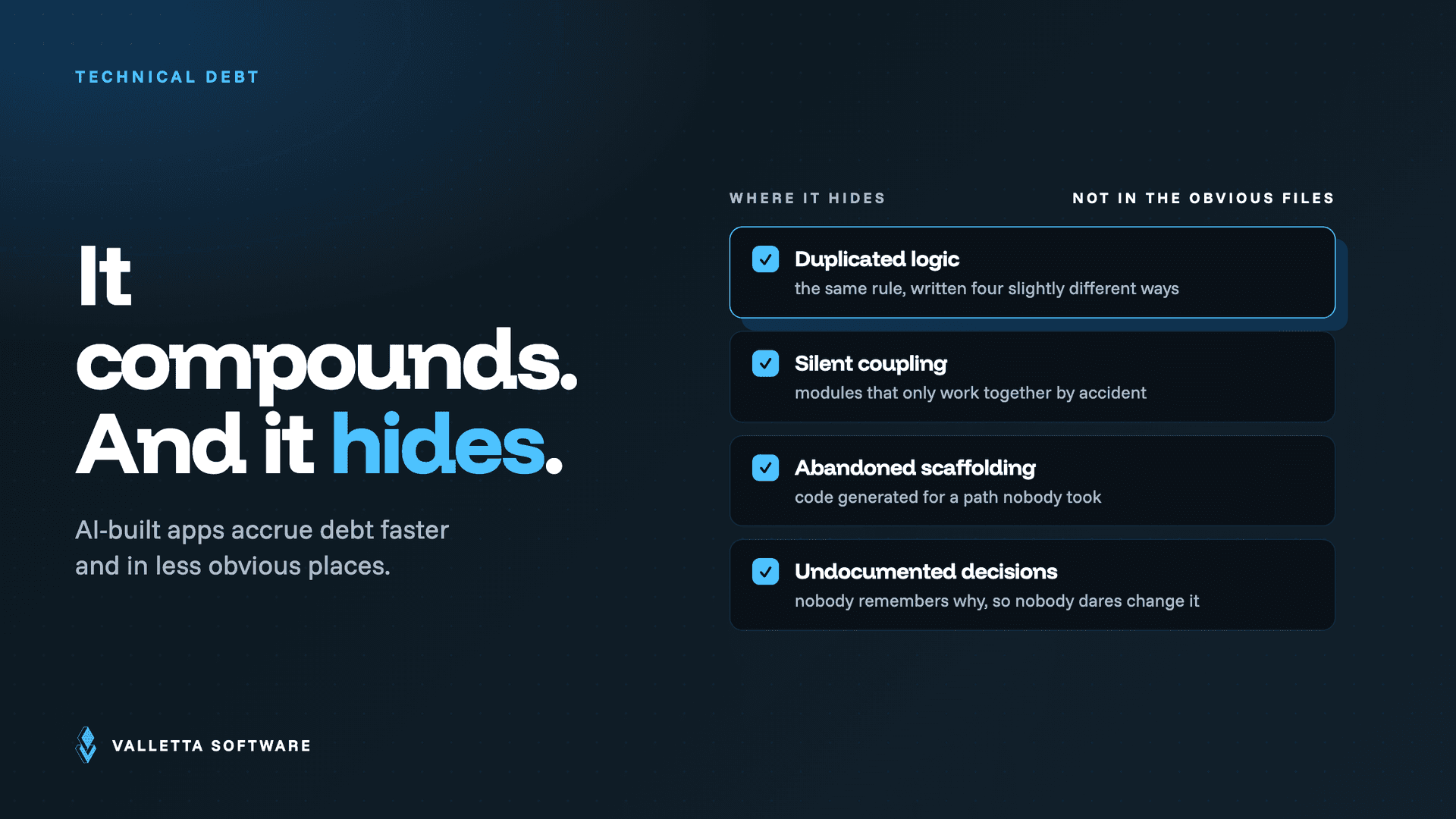

Technical debt in a Cursor, Lovable, or Bolt.new app is not the same kind of debt that accumulates in a hand-written codebase. It compounds faster, hides in places a human author would never put it, and becomes uniquely expensive to pay down because the original author often cannot read the code. The five debt categories below are the ones we see most often in vibe-coded apps that have just crossed product-market fit and need their first real engineering hire. To map the worst hotspots in your AI-built codebase, book a vibe coding audit.
Key takeaways
- AI-built technical debt is structurally different from human-written debt. It compounds faster and hides in non-obvious places.
- Five categories of AI debt: inconsistent patterns, copy-paste duplication, phantom abstractions, outdated patterns that look fine, missing operational scaffolding.
- The original author (the AI) cannot help debug it later; only a human re-read can untangle it.
- Average remediation cost is 2x to 4x what equivalent human-written debt would cost to clean.
Why AI-built debt is different
Hand-written technical debt is usually intentional. Someone made a tradeoff: ship now, refactor later. The author knows what they cut. Vibe-coded debt is rarely intentional, the AI tool made implementation choices that the human reviewer never saw, and the consequences only surface when the app outgrows its original use case.
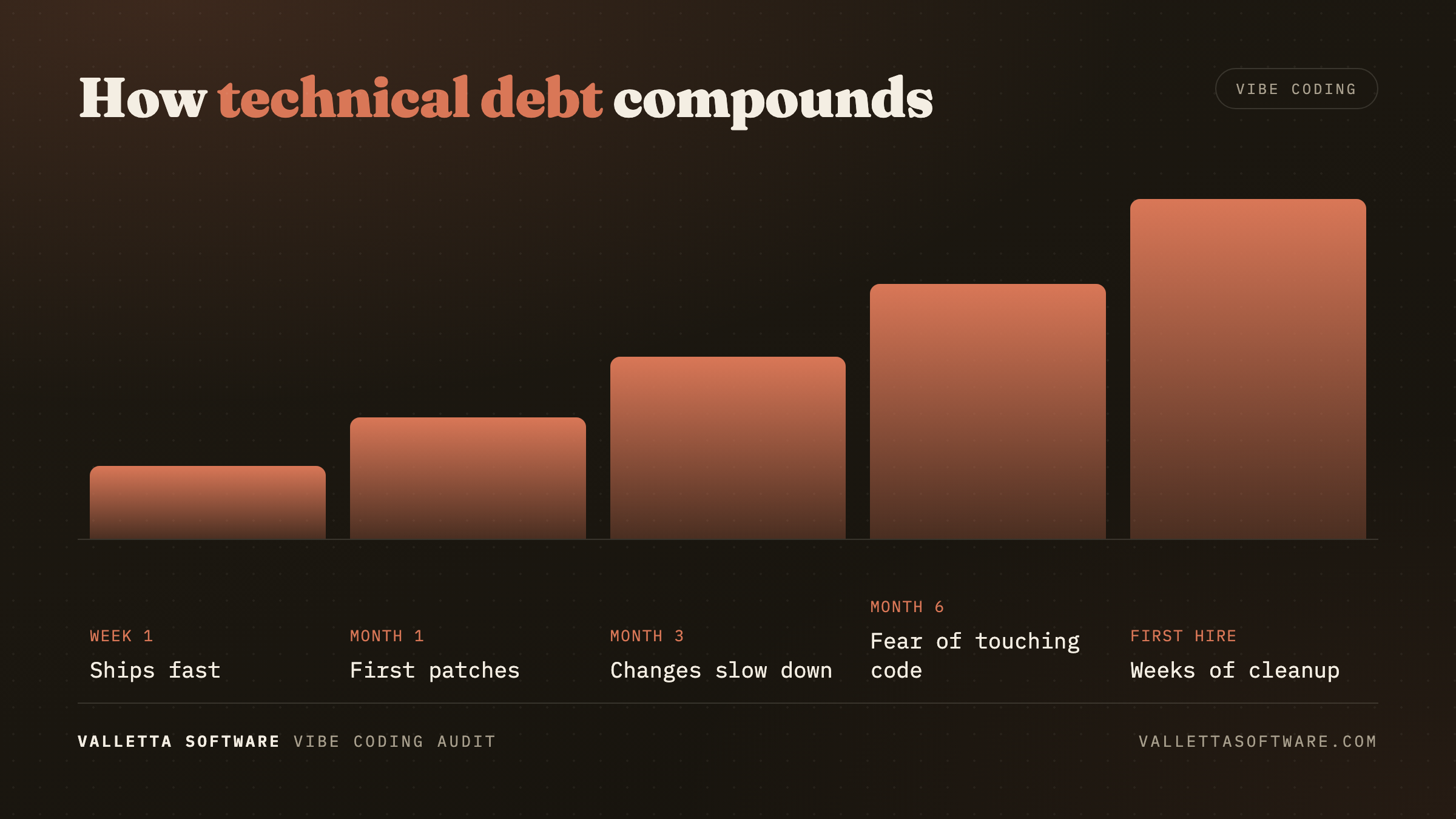
The pattern: an app built in a weekend with Cursor handles its first 100 users effortlessly. At 1,000 users, the database queries that were "just fine" start timing out. At 10,000, the auth flow that nobody read starts producing intermittent 500s. None of these are surprising bugs, they're textbook scaling issues. What's surprising is that the founder doesn't have anyone on the team who can diagnose them, because the person who built the app didn't write it.
This is the moment vibe coding stops being a productivity story and becomes a hiring story. The first engineer you bring on will spend their first month not building features, they'll be paying down debt that was invisible at launch.
1. Inconsistent patterns across the codebase
The most common form of AI-built debt. The model picks one approach for a feature, then a different approach for the next feature, because each prompt was processed independently. The codebase reads as if four different engineers wrote it, because functionally, four different model sessions did.
Concrete examples:
- Auth checked via JWT middleware in some routes, via session cookies in others, via no check at all in a third group.
- Database access through an ORM in 60% of the code and via raw SQL queries in 40%.
- Error handling that returns JSON in some endpoints, HTML error pages in others, and 500-with-no-body in a third set.
The runtime cost is small. The maintenance cost is enormous, every new feature has to be defensive against the previous inconsistency, and onboarding a new engineer takes weeks because nothing is predictable.
2. Copy-paste duplication at scale
When the model is asked for "a settings page" and then "a billing page," it often produces near-identical scaffolding for both, same form components, same validation logic, same error-toast pattern, duplicated rather than shared. The duplication isn't visible until you try to change one thing in all of them.
What this looks like in practice: a button style needs to update across the app. In a normal codebase, that's one component edit. In a vibe-coded app, that's often 12–30 separate edits, each in a file that has slightly different surrounding context.
Why it happens
The model's context window doesn't span the whole codebase. Each prompt's output is locally consistent but globally redundant. The longer the project, the worse the duplication.
3. Phantom abstractions
Sometimes the model goes the other direction, it introduces an abstraction (a base component, a generic handler, a utility function) that exists in exactly one place and is never reused. The abstraction has no payoff but does have a cost: it adds an indirection layer that future readers have to trace through.
You'll see this most often in early sessions where the prompt was something like "build this in a clean, reusable way." The model produced a base class and one subclass. The subclass does the actual work. The base class adds nothing and never will.
4. Outdated patterns that look fine
Models default to patterns they saw most frequently in training data. Frequently means 18–36 months stale. The code works, looks clean, and was best practice in 2023, but 2026's framework has a better idiom that the model didn't use.
Examples that show up regularly:
- Class components in React projects where the rest of the ecosystem moved to hooks two years ago.
useEffect-based data fetching where the framework now ships Server Components and the React Query pattern is the better fit.- Custom auth providers built from scratch where the framework now has a one-line drop-in (NextAuth, Clerk, Supabase Auth).
- Express route handlers in a Next.js app that already has its own API route conventions.
Each example is "not wrong", but it makes the code look older than the project itself, and every future engineer will lose hours wondering why the pattern was chosen.
5. Missing operational scaffolding
The most expensive debt is the things that should be there and aren't:
- No tests. The model rarely writes tests unless explicitly asked. A 5,000-line codebase with zero tests is normal for vibe-coded apps.
- No CI/CD beyond "deploy on push." No build verification, no test gate, no lint enforcement.
- No structured logging. Errors that happen in production are visible only through what the model happened to
console.log, usually not the right things. - No environment separation. Staging and production share secrets, or there is no staging at all.
- No documentation. The README is whatever the model wrote in the first commit. There is no architecture document, no onboarding doc, no runbook.
This category is what new engineers hit first. They join, ask "how do I run the tests," and the answer is "there aren't any." That conversation sets the tone for the first three months of work.
How much does it cost to pay down?
Order of magnitude, on a typical vibe-coded SaaS that just hit $10K MRR:
| Debt category | Fix cost (engineer-weeks) | Urgency |
|---|---|---|
| Inconsistent patterns | 2–6 | Before second engineer joins |
| Copy-paste duplication | 1–3 | When you need to redesign UI |
| Phantom abstractions | 0.5–1 | Low; just delete during refactor |
| Outdated patterns | 1–4 | Before scaling team |
| Missing scaffolding | 2–4 | Immediately |
Total: typically 6–18 engineer-weeks of refactoring before a vibe-coded app is ready for a team to maintain. Doing this in advance, before the second engineer joins, is dramatically cheaper than doing it after.
What to do about it
The realistic options, in order of cost:
- Audit first, then prioritize. Most of the debt is invisible until someone reads the code. The Valletta Vibe Coding Audit produces a prioritized debt inventory in 3–5 business days. You can fix from there.
- Hire a senior engineer with debt-paydown as the first 90-day mandate. Not feature work. Tell them up front: month one is hardening, month two is patterns, month three is test coverage. Then ship features.
- Rewrite the worst module. If one part of the app is uniquely painful, usually auth or billing, rewrite just that part rather than the whole app. Targeted rewrites are cheaper than they look.
- Add tests first, refactor second. Counterintuitively, tests come before refactoring. Without tests, every refactor is a gamble.
Technical debt and security are the same problem
The categories above overlap heavily with what a security review finds, inconsistent auth is both a debt issue and a security one, missing logs are both a maintenance issue and an incident-response one. Most vibe-coded apps have both kinds of debt because they share the same root cause: code that no human read carefully. For the security-specific lens, see vibe coding security risks. For the tool-by-tool defaults that produce the most debt, see vibe coding tools explained.
The hardest part is admitting the debt exists
The reason vibe-coded debt compounds is that the founder often doesn't see it. The app works. Users sign up. Revenue grows. The code is the part nobody is reading, until the first time something breaks in production and the team has to spend three days figuring out why.
The cheap version of preventing that day: read the code yourself. Pick any module, open it, ask whether you understand it. If the answer is no, that's your debt inventory starting. The slightly more expensive version: get someone else to read it. Either way, the discovery is the first work; the fix is the second.
Source: Martin Fowler on technical debt.
Frequently asked questions
Is technical debt in vibe-coded apps worse than in hand-written apps?
Different, not necessarily worse. Hand-written codebases tend to have intentional debt (shortcuts the author knew about). Vibe-coded codebases have unintentional debt (choices the author never saw). Unintentional debt is harder to pay down because there's no record of what was traded off.
How do I know if my app has technical debt?
Three signs that don't require an audit: (1) you can't explain how a given feature works without re-reading the code, (2) small UI changes turn into multi-file edits, (3) you're afraid to upgrade dependencies because you don't know what will break. Any of those means there is debt to pay.
Should I rewrite the whole app or refactor in place?
In place, almost always. Full rewrites have a track record of taking 3x longer than estimated and reintroducing the same debt in new forms. Targeted refactors on the worst module are nearly always the right move.Can I avoid debt by giving the AI better prompts?
Partially. Asking for tests, specifying patterns, and providing architectural constraints in the prompt all reduce debt accumulation. None of these eliminate it, the gap between "what the model produces" and "what a senior engineer would produce" is the debt, and prompting alone doesn't close it.
What's the ROI of paying down debt before scaling the team?
Order of magnitude: every engineer-week spent on debt before the second hire saves roughly three engineer-weeks of confused work afterward. The arithmetic works because debt is most expensive when it's being navigated, not when it's being fixed.
Frequently asked questions
- Do AI coding tools create technical debt?
- Yes, often faster than handwritten code. AI tools tend to duplicate logic, generate inconsistent naming, and bypass abstractions that a senior engineer would introduce.
- What does technical debt in a vibe-coded app look like?
- Duplicated functions, copy-pasted styling, ad-hoc state management, mixed paradigms, and inconsistent error handling are the most common patterns.
- How do I clean up technical debt from AI-generated code?
- Start with a senior-engineer audit to map the worst hotspots, then sequence the fixes by commercial risk: security first, then scalability, then maintainability.
- Can I keep vibe coding after a remediation sprint?
- Yes, but with guardrails: code review, linting, automated tests and a senior reviewer on every meaningful change.
- Does technical debt block fundraising?
- It can. Most investors run a code review during due diligence, and severe technical debt either slows the round or lowers the valuation.
Map the Technical Debt in Your AI-Built App
Get a prioritized remediation roadmap from a senior engineer. The Vibe Coding Audit covers maintainability, scalability and investor-readiness. From $199.
Updated June 2026: the technical-debt patterns were reviewed for 2026 and a foundational reference on technical debt was added.